National Geographic Biodiversity Assignment, The Purpose Driven Photo
Before anyone gets too excited, I was not on a direct assignment from National Geographic. But I have no problem saying I was on an indirect assignment from National Geographic, and you could be too!

Editors and Staff Photographers from Nat Geo moderate the Your Shot online community. This is a place for photographers of all skill levels to host their photos and participate in assignments. And if your photo is selected it will be published in a story and possibly in the magazine.
The most recent assignment was "Biodiversity". Biodiversity is such a broad topic, the editor left it up to the photographers to show him what biodiversity looked like to them. This is what biodiversity looks like to me and these are my submissions to the story.
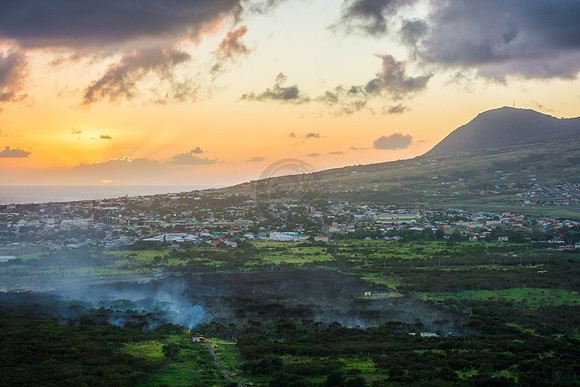
This first photo was taken on top of a water reservoir overlooking Half Moon Bay on one side, and Basseterre on the other. Fires frequently start in the cane fields here in St. Kitts and, whether they are prescribed or not, can be very beneficial to the ecosystem.
"As one of the most important natural agents of change, fire plays a vital role in maintaining certain ecosystems. Prescribed fire reintroduces the beneficial effects of fire into an ecosystem, producing the kinds of vegetation and landscapes we want, and reducing the hazard of catastrophic wildfire caused by excessive fuel buildup." (http://www.smokeybear.com/prescribed-fires.asp)
Many species, from Mongoose to Cattle, depend on the cane fields, and a fire can be a great way to rejuvenate this ecosystem by clearing undergrowth and allowing new, young plants to thrive.
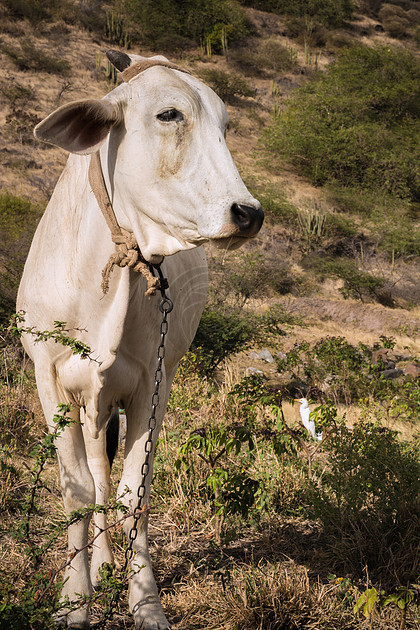
With the next photo, I wanted to show the relationship of some of the local animals; particularly the cow with the cattle egret. It is a beautiful symbiotic relationship in which the cow stirs up grasshoppers, and other bugs as it grazes, for the egret to eat and the egret eats bugs that can be a nuisance to the cow. Locally, farmers keep their cattle on chain or leash to keep them from wandering too far. I have even seen them tied in residential plots.
This image was meant to capture the interdependent relationship of this smaller ecosystem. I went back to this cow 4 times in 3 days. The first day I didn't even take my camera out of my bag. It was photographed in the area where my last camera was stolen. The memories and anxiety became more of a focus than the cow and I decided to leave. The next 2 days were spent almost developing a relationship with the cow. We started from a distance. I could tell she was skittish and uneasy and, frankly, so was I. Over the next day and 2 more visits she became comfortable with my presence. At one point she moved curiously toward me and I twitched in the same manner she would have; our boundaries were set. Fortunately, it was close enough to get this image and she was comfortable enough to pose for me.
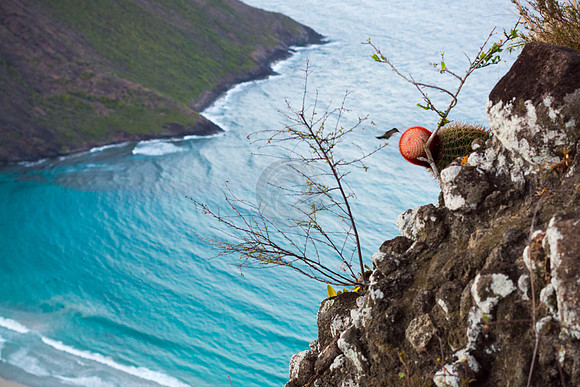
The third and final image I submitted was taken at about 1000 ft above sea level, which is significant because we started at sea level. Two of my friends and I went out for a sunset hike to one of the most scenic spots on the peninsula. With only intentions of enjoying the sunset and taking photos of that, an opportunity presented itself. After hiking though dry brush and thorns, we reached our rocky destination. Growing on the ledge, the only color aside from the sunset, was a Melocactus. Then, with a quick zip as they do, a hummingbird shot out of nowhere and honed in on one of the tiny cactus flowers. Before I could get my camera up he was gone, but I was ready. I set my exposure and focus and waited to see if he would return. He did, but not for long. I had enough time to shoot one frame, the one you see here. The next one I snapped showed him as a blur on the edge of the frame. It was interesting to me that such a small creature would find itself at this elevation and with all the flowers blooming at sea level, this hummingbird was after a flower more his size in the middle of rocks, thorn bushes and dry vegetation.
These three photos were taken with a common theme in mind: telling a story. It was my goal with these photos to try to tell something more than just pretty colors and nice lighting; to try to pique the interest of the viewer. This is one thing that the National Geographic editors look for. Will these photos be published? Most likely not. There is a plethora of great photos submitted to these assignments. But the Your Shot community and assignments are a great way to get an idea of where you stand among our peers. And it's a great way to push yourself. I take it as an opportunity to be critical of my images with a purpose. I encourage you to get involved as well. There is no charge, and no risk. It's a great way to host your photos and get feedback as well as see examples of great photographs and hear, from Nat Geo editors, what makes them great.
Follow me on Facebook and follow this blog to see and hear more about what is going on in my world of photography. And don't forget to check out my landscape work in the Landscape Gallery.
